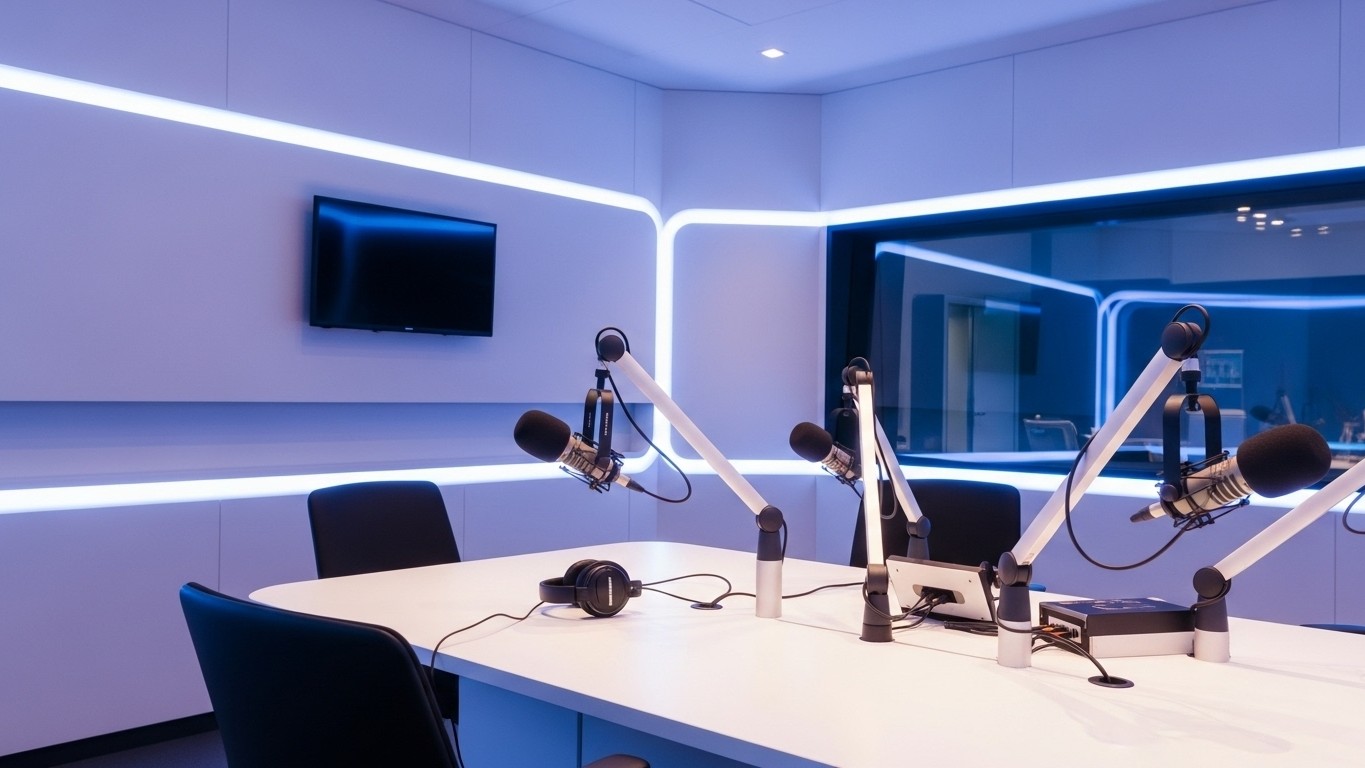
When radio began over a hundred years ago most of our studios were on a main drag, but on the outskirts of town so we could have the towers close and get cheaper land. A few years later when radio pioneers like George Marti, a man that I was lucky enough to have lunch with before he passed and soak up some of his vast radio knowledge, made remote STLs more reliable that allowed some stations to move their studios into town to more high-traffic locations. Some of them even created street-level showcase studios allowing passersby to watch the on-air talent as they were broadcasting live. However, when the monopoly laws changed in the mid-90s and consolidation took place, the majority of radio studios were moved into office buildings and, for the most part, they all began to look roughly the same. About a 10x12 room with stand-up height studio furniture, a large console on top, automation computer, some audio equipment in racks and a couple of mics on over-head mic-booms. As digital content became more important in the 2000s we saw a handful of stations begin to break out of that mold and build studios that were more video friendly, I’ve helped design a few myself. But recently I’ve been asking this question a lot, how do we create modern radio studios that maximize our talent’s ability to create content? Here are a few thoughts on that.
Versatility and flexibility are key. During the two TAB panels I moderated recently, Big Time Content on a Small Time Budget and Extending Your Brand Online both of which you can see on my Radio Influencers podcast, I asked two of my expert panelists their thoughts on creating video-friendly radio studios. Those experts were a brilliant engineer, Daniel Hyatt with DNav Inc, and a video producer and director, John Reynolds with Middlin Creative and the host of Radio Update’s Video Tips & Tricks Series. Both of their answers to my questions focused on making our spaces more flexible, versatile and clutter-free. John also talked a lot about sightlines and the importance of using low-profile mic booms. Somthing I’m a big proponent of myself.
But, what do flexible and versatile studios look like in practice and how can we convert current radio studios to fit that model? Basically, we do these eight things.
- We get as much audio equipment as possible out of the studios and into engineering rooms
- Cut down on the number of computer monitors and put the remaining ones in trenches to organize and hide cables and get them out of the sightlines
- Get a smaller console and low-profile mic booms for the mics
- Shrink the size of the console furniture, make it height adjustable, and put it on casters so it can move within the room (Wire accordingly)
- Install studio lighting that adjust for the different positions/shots and install multiple small cameras (eye-level, close to the talent but mounted where they’re hard to notice)
- Wire all of this up where the cameras are always rolling when talent are on the air and make it where all the talent have to do is hit a button and they are live-streaming video to all the station’s platforms
- Then, repeat that process in every on-air and production studio and pair them with smaller, solo audio/video studios and talent’s home studios
- Use a service like Riverside to allow talent to record high quality audio/video with anyone from anywhere in the world
If you need help with all of this, use my scheduling link to set-up a meeting and talk about becoming a consulting client.
Good news is, there are also ways to make some non-traditional revenue from studios designed like this. When not in use we can rent them out as audio/video podcast studios, something there’s a real market for now in all size markets. The prices generally range anywhere from $60 to $150 an hour with upcharges like adding a producer/engineer. I know, because every town I travel to I check this to see if there’s a nice, affordable one close to my hotel I can use instead of bringing along my gear. Although I’m doing that less and less as I shrink down the footprint of my travel gear. By the way, if you’re thinking that renting out studio space is just another thing to add to someone’s plate (or your own), there are ways to automate booking/managing it as well.
What do you think? How have you set up your studios to maximize content creation?
Pic AI generated by Envato Elements.